

A Dangerous Antidote: A Review of Bates' Gospel Allegiance
/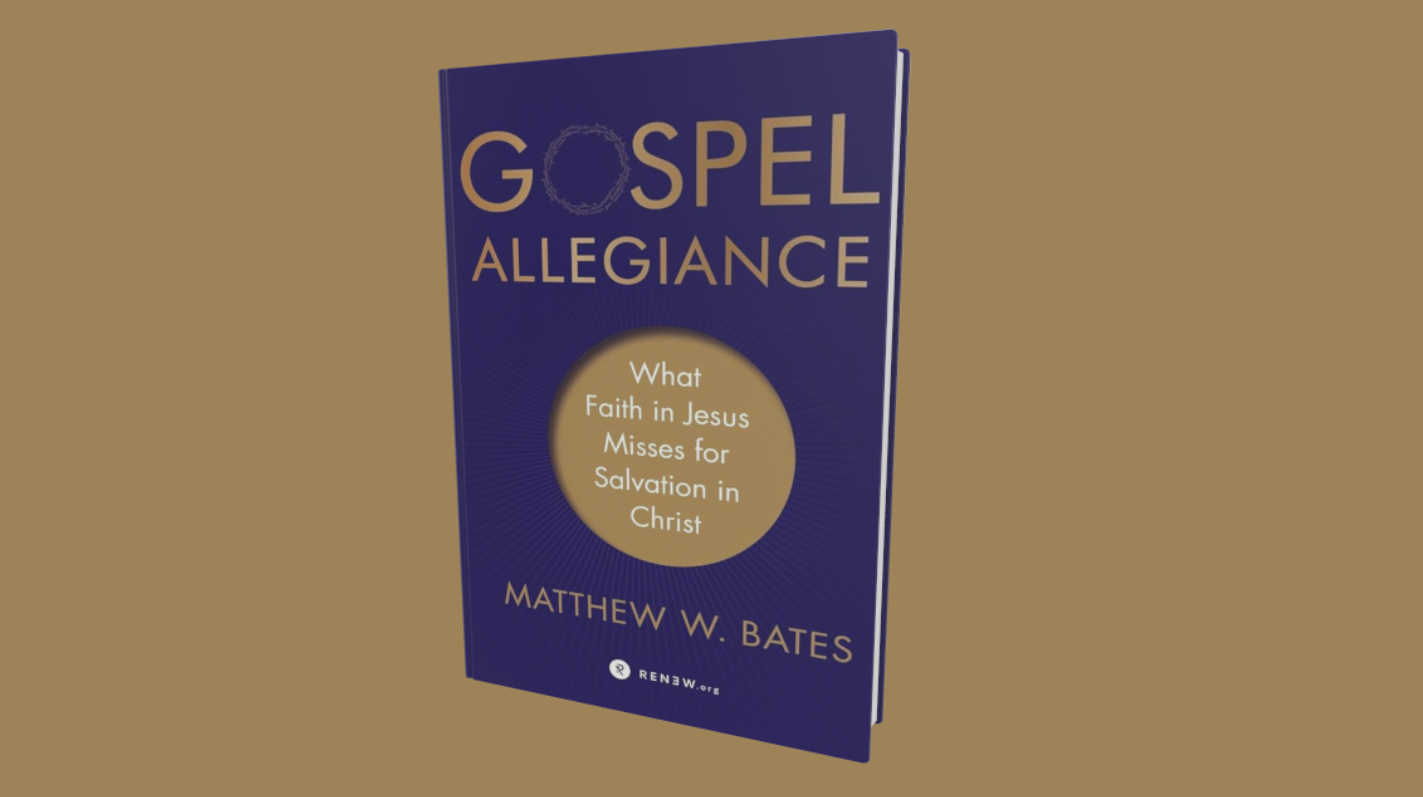
Matthew Bates’ newest book, Beyond Salvation Wars: Why Both Protestants and Catholics Must Reimagine How We are Saved, is creating a stir in the Reformed evangelical world. The Reformed reader can guess from the book’s subtitle why this is the case. Any call for Protestants and Catholics to reimagine salvation together is a call to depart from the Bible’s teaching concerning salvation. My point in this article is not to judge Bates’ newest book by its cover. However, Bates’ arguments in his newest book are built on the book he wrote in 2019, Gospel Allegiance: What Faith in Jesus Misses for Salvation in Christ. Therefore, it seems prudent to put forward a biblical/theological review of the former to give the reader biblical discernment and warnings in considering Bates’ proposal overall in his work.
Reviewing the Prescribed Antidote
Bates begins his book by alerting his readers to the rampant misunderstanding of the gospel by many prominent pastor-scholars. In this book, Bates attempts to “describe the gospel and saving faith with greater clarity” (14) because the older salvation models are “inadequate” in conveying what “Scripture teaches about salvation” (15). Consequently, he calls for the church to embrace a new model of salvation, “gospel allegiance,” to give the church better language to proclaim the gospel (15). He divides the book into two parts. In the first part, “Discovering Gospel Allegiance” (chapters 1-3), Bates delineates what the gospel is by unpacking what he calls “the gospel proper” (86-87). Then in the second part, “Advancing Gospel Allegiance” (chapters 4-7), Bates discusses how grace, faith, and works adhere together in this new model that he is proposing.
“Part One”
Moving into chapter one, Bates begins by stating negatively and positively what the gospel is and is not. First, negatively Bates states that the gospel is not vague Christian activities, the Romans road, justification by faith, nor cross-centered (32-40). Then, Bates moves on to positively unpack the “specific content of the gospel” (40-41). According to Bates, only a few texts delineate specifically what the gospel is, and these passages must be the alpha point in defining the gospel.
Bates looks first at Jesus’ proclamation of the gospel in Mark 1:14-15 and Luke 4:18-19 (41-46), and then, he examines Paul’s articulation of the gospel in Romans 1:1-4 and 2 Timothy 2:8 (46-54). According to Bates, Jesus’ proclamation of the gospel centered on the arrival of the kingdom and the promised Christ who came to secure “universal sovereignty at the right hand of God the Father.” Paul, likewise, spoke of the gospel as the divine announcement of the arrival of the promised king, the son of David, who died, rose, and was vindicated by the Father as Lord. (54-55). In other words, the specific content of the gospel, argues Bates, is “only” the objective historical work of the Son of God in history as the son of David and promised Messiah from incarnation to exaltation as sovereign LORD (55).
In the next chapter, Bates examines the Greek word pistis and contends that “allegiance” would be a more faithful translation of this word when contextually referring to a “saving response to the gospel” (61). He discusses the semantic range of pistis by showing that there are a handful of texts where pistis could be better translated as “faithfulness” (61-64). However, Bates is quick to affirm that pistis does not always mean faithfulness. But his point is that pistis has a multiplicity of ways that it can be translated depending on its context (64-66). This leads to Bates’ third discussion point, “how words mean things” (66-68). Bates points out that the context of a word determines its meaning, and the lexical range of pistis can either be translated as faith or faithfulness. He argues that when pistis is used in connection with a “royal social frame,” then it should be translated as the latter, “faithfulness” or “allegiance” (68). Closing chapter two, Bates seeks to tighten the connection between the gospel and allegiance by evaluating the purpose of the gospel and the meaning of the “righteousness of God” in Romans (71, 81).
In the third chapter, Bates further unpacks “The Full Gospel of the King.” The gospel is the reality that Jesus is the king who saves. Bates writes,
The gospel is the true story of how Jesus the Son was sent by God the Father to become the saving king who now rules forever at his right hand through the sending of the Holy Spirit, fulfilling God’s promises in Scripture (86).
Bates argues that this is the “gospel proper,” and the only proper way to understand these events is within a royal framework (86). After unpacking the ten events of the gospel (87-104), Bates addresses a few objections to the royal gospel (105-110). Bates, in response to these objections, further emphasizes his distinction between the “gospel proper” and the gospel result, Christ’s achievement and man’s response (105, 107). Applying the gospel proper to “Christendom,” Bates argues that the confession of the “gospel proper” is grounds for unity amongst Roman Catholics, Protestants, and Eastern Orthodoxy (111).
“Part Two”
Transitioning into part two of the book, Bates in chapter four discusses how faith can include works in a gospel allegiance model without supplanting grace. The gospel is the “specific gift from God,” wherein God gives humanity the “Christ-gift” (123, 125). Bates contends that a generic or abstract understanding of grace creates a “salvation culture” wherein the gospel becomes primarily about how people get saved (124).
From here, Bates discusses six dimensions of grace, relying on John Barclay’s work in Paul and the Gift. These six dimensions are merit, size, desire to benefit, timing, effectiveness, and return-gifting. The Christ-gift was given without any “regard to universal human merit or worth” (130). Grace is continually growing (132), and God desires through the Christ-gift to share grace with humanity in a way that is “maximally benevolent” (135). In the timing of grace, God chose the Son and the corporate body that is found in him for salvation in eternity past (139). Saving grace is effective by the work of the Spirit in the midst of the corporate body (144). Last, the Christ-gift of the gospel requires a return gift, “embodied loyalty to Jesus Christ the king” (146).
Moving into chapter five, Bates emphasizes faith as an imbodied activity that cannot be reduced to a mere internal attitude (149-159). Bates main critique of the “Protestant model” is that faith is internalized and works are merely external evidences but are not the basis for salvation (152). After looking at the faith of Abraham, he goes on to remind his readers that the gospel is the kingship of Jesus and demands the allegiance of the nations. Therefore, Bates writes, “This is why saving faith is not trusting the promise that Jesus’ merit counts as righteousness for us” (158).
From here, Bates gives a brief history lesson from Luther to Bultmann to demonstrate how faith became internalized (158-161). Then, he gives a positive case for faith being external through three main points: spiritual and physical bodies are not separated, salvation brings about the “colonization” of the Spirit in the body, and faith is bodily (162-166). Before closing the chapter, Bates appeals to Jesus as the perfect example of embodied faith (166-171), and then, he contrasts gospel allegiance and works of the law from Galatians 5:1-6 (172-175).
Continuing into chapter six, Bates takes his embodied faith model and asks the question how works are saving in light of that model. According to Bates, the problem is not works, rather the problem is older salvation models (178-182). Bates affirms that the Bible is clear that no one can be “declared innocent by God by our works.” However, he also says that works are necessary for salvation since evil deeds result in God’s judgment, and good works are determinative for one’s final salvation on the day of judgment (182-184). While the Protestants have tried to circumnavigate Paul’s words in Romans 2 because it threatens a “faith-alone system,” Bates contends that good works can be brought into justification by faith alone when saving faith is seen as allegiance (185). Bates argues that Romans 2 must be interpreted to mean that works have “a positive saving role within allegiance as part of the basis for our justification and final salvation" (192-193).
From here, Bates appeals to “The New Perspective on Paul” to further unpack the relationship between faith, grace, and works (193). Bates is critical of some of the specific details of the New Perspective on Paul. However, he is in favor of the basic argument of Sander’s covenantal nomism and other scholars’ interpretation of the Pauline phrase “works of the law” as referring not to the law in total but rather to the ethnically dividing laws in the Mosaic covenant that separated Jews from Gentiles (197-200). Bates concludes chapter six by summarizing Paul’s conception of the law, giving an appeal for unity amongst Protestants, Catholics, and Eastern Orthodox. He contrasts what is meant by works in Rome’s salvation model versus what is meant by works in the “gospel allegiance” model (200-210).
The last chapter is Bates’ conclusion/ application, where he shows how “gospel allegiance” impacts doctrine, pastoral care, and missions. Here, Bates does not offer any new arguments for his proposal. But he does attempt to show the value of gospel allegiance in the life of the local church from preaching, assurance, and discipleship.
The Warning Label on Bates’ Antidote
Jesus is king! Bates has highlighted a deficiency in mainstream evangelicalism, a gospel with no king. The kingship of Christ is essential to the gospel, and Bates calls for the return of the kingly gospel. He has demonstrated from Jesus’ proclamation and the writing of Paul that the “gospel proper” or cosmic gospel is the objective historical work of the Son of God in history as the son of David and promised Messiah from incarnation to exaltation, establishing the kingdom of God as sovereign LORD (55). Bates is correct that there is a prominent “salvation culture” in evangelicalism where the gospel is the Christian’s benefit package, a sort of consumerism writ large in the church where discipleship is severed from salvation, Christian activities are confused for the gospel, and faith itself becomes the focal point of salvation. However, Bates’ antidote for evangelicalism’s plight is to distinguish the gospel proper (cosmic gospel) from the gospel response (personal gospel), establishing a new salvation model of gospel allegiance that brings works into justification by faith. Unfortunately, while he has rightly identified a serious ailment in the church, his proposed cure is as deadly as the original ailment. The dangers on the warning label are as harmful, and perhaps, worse than the ailment itself.
Bates writes, “The good news is about Jesus’ achievements, first, as established gospel fact; our personal saving benefits derive from and are contingent upon Jesus’ achievements. They are not part of the gospel proper” (107). One of Bates’ main contentions throughout the book is that justification by faith alone (“actualized forgiveness”) is not the center of the gospel. The gospel proclamation is only the divine announcement of “possibility of the forgiveness of sins” (1 Cor. 15:3), but all saving benefits are outside the gospel proper. Bates stakes a large portion of this narrow gospel definition by arguing that only texts that are explicitly speaking of the gospel content should be examined to understand what the gospel is (41), and since not a single "gospel text" equates or talks about justification, faith, or righteousness, then none of these things are part of the gospel. Bates notes that Romans 1:16-17 and Galatians 3:8 only “appear” to equate the gospel and justification by faith (37).
A Biased Selection of Texts
A few things should be noted regarding Bates’ exegetical methodology and conclusion. First, there is a deafening assumption by Bates that the absence of a word means the absence of the concept in a given text. Second, in his exclusive focus on “specific gospel texts,” Bates fails to deal adequately with texts that speak of the “gospel preached,” such as 1 Corinthians 1:17-30, and how those shape our understanding of the gospel. Third, Bates’ reading of Romans and Galatians is strongly impacted by his adherence to the New Perspective on Paul. Fourth, while Bates extensively interacts with several “specific gospel content” texts, he ignores others that include “gospel benefits” as part of the gospel. For example, in 1 Timothy 1:15, Paul unpacking the gospel of the glory of the blessed God (1 Tim 1:11) writes, “The saying is trustworthy and deserving of full acceptance, that Christ Jesus came into the world to save sinners (1 Tim 1:15).”
A Deficient Federal Theology
The gospel is not only the declaration that Jesus is King, but that he came as King to actually save sinners. There is an objective cosmic gospel reality, Jesus is the King, and a personal subjective gospel reality, Jesus saves sinners. The two should be distinguished, but they cannot be separated. The decree of God will not allow them to be severed. Christ’s priestly prayer will not allow them to be severed. Christ’s federal work as the second Adam for the elect will not allow them to be severed. The doctrine of union with Christ will not allow them to be severed. Abstracting the person and work of Christ from the salvation of sinners in the “gospel” is to sever the promised suffering King of the Old Testament from his promised people given to him by the Father in whom he has come to save through his suffering (Jn 6:35-40; 2 Tim 1:9-10). The decree of God to save a particular people in Christ cannot be bifurcated from the work of Christ in time for that particular people, as if the gospel proper is only about the “possibility of forgiveness of sins” for those people.
Herein lies a key theological deficiency in Bates’ treatment of the gospel. He has an anemic federal theology spawning from Arminianism. Bates accuses Reformed theology of making grace an abstract concept (123-124), but I would contend that Bates’ Arminianism and doctrine of corporate election not only abstracts grace but also cheapens grace, for it is not effectual or sufficient. Christ died for an abstract corporate body only to make that body “savable.” Ironically, Bates would decry “cheap grace” towards a Protestant view of salvation,[1] only in turn to propose a neo-nomianism gospel like what we find in the character Ignorance in Pilgrim’s Progress.
The character Ignorance believed that Christ’s death for sinners makes it merely possible for sinners to be justified, but faith in Christ alone does not justify. Faith in Christ opens the door for sinners to be justified through their own imperfect obedience to the law. Bates’ gospel, like Bunyan’s character, undermines Christ’s federal headship for the elect of God, and imports a work principle into justification. He may not explicitly deny the active obedience of Christ or imputation of righteousness, but his gospel paradigm severs the roots of these doctrines, leaving them to rot. Meredith Kline’s proverb continues true–failure to affirm a works principle in the garden will result in bringing a works principle into the gospel through the back door. Only Reformed theology can teach the fullness and freeness of the gospel received, whereby sinners are justified by faith alone on the basis of Christ’s work alone, while simultaneously teaching that good works are the necessary and inevitable fruit of salvation that is wrought by the Spirit in sanctification (Eph 2:8-10). Apart from federalism, the foundation of the gospel will be washed away, leaving the sinner to pursue sanctification in order to be justified.
Christ the Priestly-King
Last, Bates leaves the reader with questions regarding the relationship between the office of the king and the priesthood in a royal gospel scheme. The writer of Hebrews weaves together the offices of king and priest throughout his epistle as he unpacks Christ as the fulfillment of Psalm 110. The kingship of Christ is not antithetical to or superior to the priesthood of Christ in the epistle. Hebrews 10:11-14,
And every priest stands daily at his service, offering repeatedly the same sacrifices, which can never take away sins. But when Christ had offered for all time a single sacrifice for sins, he sat down at the right hand of God, waiting from that time until his enemies should be made a footstool for his feet. For by a single offering, he has perfected for all time those who are being sanctified.
Notice, the movement from priestly mediatorial language to kingly enthronement language back to priestly language. The point is that Christ appeared at the “end of the ages” to put away sin by bearing the sins of many as their mediator and priest, accomplishing objectively their salvation (9:15, 25-28). Bates has framed the discussion in terms of either/or rather than both/and. Jesus is the priest-king. Jesus is our kingly priest. Both offices and both aspects of the gospel (cosmic and personal) are part of the gospel.
Conclusions
In short, Bates’ book fails to offer what the title suggests. The “royal gospel” is a small gospel that has severed Christ from his elect people and his kingship from his priesthood. A gospel that imports works into justification, robs Christ of His federal work for the elect, and calls for unity among Protestants, Catholics, and Eastern Orthodox is a deadly poison.
[1] A separate point could be made concerning Bates’ misunderstanding of the Reformed traditions’ view of good works, sanctification, and how they relate to the Christian’s salvation.