

The Nations Participate in Building God's House
/
Throughout the Scriptures, God dwells in many various places by his special presence so that his people might be with him. While the Scriptures insist that nowhere can possibly contain the fullness of God (1 Ki 8:27), they also emphasize the uniqueness of the locations where God chooses to dwell among his people. In the Old Testament, the two primary dwelling places of God with man are the tabernacle and the temple. Both of these are constructed by and for God’s people, Israel. However, The Old Testament slowly develops a pattern in which it is seen that all the nations and their wealth will participate in the building and beautifying of God’s dwelling place with man. In order to demonstrate that the nations have always participated in the dwelling place of God, The nations’ inclusion in building and beautifying the dwelling place of God will be traced from the tabernacle to the rebuilding of the temple, the pattern of the nations’ inclusion will be established in Psalm 68, and then the pattern will be further developed from the latter prophets. Finally, this pattern will be organically linked to Eden.
The Nations’ Inclusion in the Building of God’s Dwelling Place in the Historical Narratives
When God gave Moses instructions for the building of the tabernacle, the Israelites gave many costly materials for its construction. The Israelites, a people just released from slavery and wandering through the desert, had received these materials from Egypt. Carpenter writes, “According to the canonical records, they were provided by the Egyptians themselves through God’s sovereign intervention.”[1] God had foretold this to Abraham and Moses, and it occurred exactly as he said. “The people of Israel had also done as Moses told them, for they had asked the Egyptians for silver and gold jewelry and for clothing. And the Lord had given the people favor in the sight of the Egyptians, so that they let them have what they asked. Thus they plundered the Egyptians” (Ex 12:35–36 cf. Gen 15:14).[2] Two further points in Exodus support the notion that the tabernacle was built with plundered materials. Firstly, it is noted that when Aaron took up a collection for his unholy calf worship, he said, “Take off the rings of gold that are in the ears of your wives, your sons, and your daughters, and bring them to me” (Ex 32:2). It is explicitly stated that Israel plundered the Egyptians of gold jewelry, and that gold jewelry was used to form the golden calf. Given the similarities between the two collections in Exodus 25 and 32, which were both taken up for the creation of objects used in worship, it is likely the two collections were taken up from the same plundered goods. Further, two of the most prominent costly materials used in the construction of the tabernacle were gold and thread. This corresponds well to the precious metals and garments that Israel is said to have received from Egypt. This does not exclude that some of the materials may have come from other sources, but it does show that a substantial portion of the tabernacle’s materials came from Gentile Egyptians as they gave favorably to the Israelites. When the tabernacle was made, it was made with the wealth of the nations.
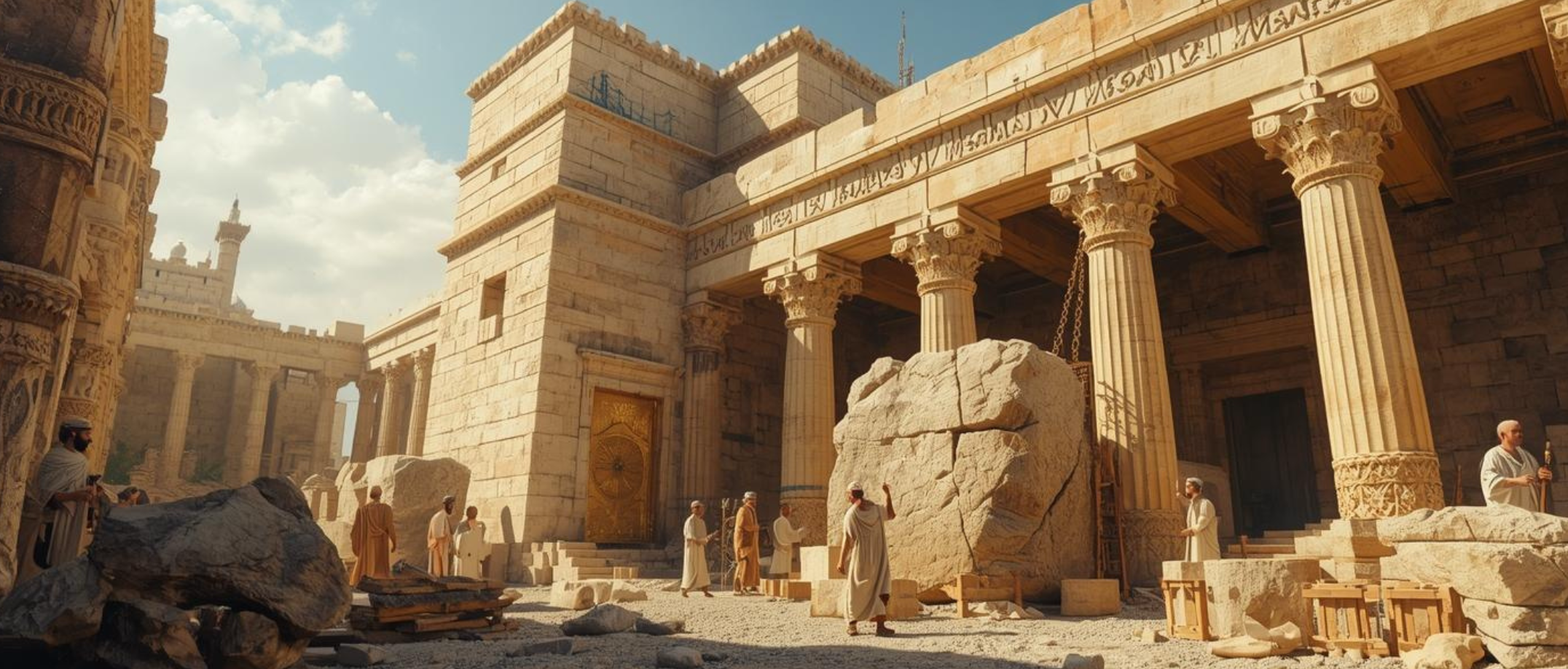
In 1 Chronicles, David began to make the preparations for the temple that his son Solomon would build for Yahweh to dwell in. David gathered together many materials. The Sidonians and Tyrians brought great quantities of cedar to David. 1 Kings 5 reiterates that the cedar used in the construction of Solomon’s temple came from Hiram the king of Tyre. The author of Kings is careful to note that Hiram acts favorably toward Solomon because, “Hiram always loved David” (1 Ki 5:1). Solomon’s temple was not only constructed by materials from the nations, but also built by the nations. David had gathered together resident aliens in Israel for the building of the temple (1 Chr 22:2), Solomon did likewise (2 Chr 17–18), and even one of the master craftsmen of Solomon’s temple was the son of a man of Tyre (13–14). Solomon’s temple was constructed with labor and material from the nations.
David’s desire to build the temple for God is in the context of the Lord giving rest to David from all his enemies (2 Sam 7:1–2). David had conquered many surrounding enemies and received great plunder from his conquest that he dedicated to the Lord (2 Sam 8:11). It would seem David’s desire was to use this plunder to build a house for the Lord. David was told that he would not build the temple, but he did make preparations for Solomon’s construction of the temple. Connecting this to the building of the tabernacle and the exodus, Hamilton writes, “This pattern of the plunder of the enemies being used for the building of the dwelling place of God is repeated when David stockpiles the wealth of the nations for Solomon to use in the construction of the temple.”[3]
The rebuilding of the temple after the exile followed a similar pattern. God stirred up king Cyrus so that he proclaimed, “Whoever is among you of all his people, may his God be with him, and let him go up to Jerusalem, which is in Judah, and rebuild the house of the Lord, the God of Israel—he is the God who is in Jerusalem. And let each survivor, in whatever place he sojourns, be assisted by the men of his place with silver and gold, with goods and with beasts, besides freewill offerings for the house of God that is in Jerusalem” (Ezr 1:3–4). Cyrus was favorably disposed towards God and his people, so that the exiles returned to Jerusalem generously supplied by those they lived around them (Ezr 1:6). The similarities between the exodus from Egypt and the return from exile are notable. Just as there was an offering for the tabernacle, the Israelites made an offering for rebuilding the temple, “to erect it on its site” (Ezr 2:68). Ezra says this collection consisted of three things: gold, silver, and garments (69, cf. Neh 7:70–72). These are the same three objects plundered from the Egyptian.
When the rebuilding ceased temporarily, king Darius decreed that it should begin again, even going so far as to fund the labor of the work from the royal revenue (Ezr 6:8). King Darius’s provision extended to providing for the daily sacrifices to God. At the rebuilding of the temple, not only was the building funded by the wealth of the nations, but the daily provisions for sacrifices were provided too. The wealth of the nations, particularly the wealth of kings, was instrumental in the construction of the three major dwelling places of God in the Old Testament. The wealth was sometimes plundered, sometimes given out of favor for Yahweh and his people, and sometimes the wealth was both plundered and freely given, even from the captors of the Lord’s people.
The Nations’ Inclusion in the Building of God’s Dwelling Place in Psalm 68
Psalm 68 ties together many of the themes already presented. The psalm itself is a processional psalm, likely written for the procession of the Ark of the Covenant from the house of Obed-edom into Jerusalem (2 Sam 6).[4] The psalm speaks of God’s salvation of his people and his conquering of the rebellious. Throughout the psalm it is clear that the dwelling place of God is sharply in the David’s mind, through reference to dwelling (16, 18), sanctuary (17, 24, 35), house (5, 16), temple (29), and Sinai, a former place of God’s presence (8, 17). Psalm 68 is also concerned with the gifts given for the sanctuary (18, 29).
Throughout Psalm 68, there are numerous allusions to the exodus and the victory of Deborah and Gideon in Judges 5.[5] This is particularly important to the interpretation of Psalm 68, because these allusions establish the existence of a pattern of God’s victory. Firstly, the song of Deborah is a recapitulation of the Song of Moses in Exodus 15. They are both victory songs occurring after the Lord’s deliverance of his people from their enemies. Psalm 68 stands as a continuance of this pattern, for it is also a victory song of God’s deliverance. This conclusion is further suggested by verse 19 which Hamilton argues exists at the middle of the Psalms’ chiastic structure.[6] The verse says that God “daily bears us up.” Kidner says the word daily, “links the story of the redemption firmly with the present and the future.”[7] Psalm 68, by alluding to this pattern and participating in the pattern itself, establishes an expectation that God will deliver the people in this manner again. Barnes writes of the Psalm, “It was in view of past triumphs… It was in anticipation of future triumphs.”[8] The existence of this deliverance pattern has special implications for the dwelling place of God with his people. The deliverance of Israel from Egypt resulted in plunder for the building of the tabernacle, and God’s conquering of David’s enemies supplied David with plunder for the building of the temple. While Israel’s deliverance from Sisera in Judges 5 did bring spoil for the people, it is admittedly not explicitly linked to the dwelling place of God.[9]
As mentioned, two verses in Psalm 68 mention gifts given by men in the context of the sanctuary. Verse 18 says, “you ascended on high, leading a host of captives in your train and receiving gifts among men, even among the rebellious, that the Lord God may dwell there.” Hamilton understands the gifts of Psalm 68:18 to refer to plunder that is dedicated to the building of the Lord’s dwelling place.[10] It is important to remember that the Egyptians freely gave this plunder to the Israelites who then gave it themselves for the building of the tabernacle. In verse 29 it says, “because of your temple at Jerusalem, kings shall bear gifts to you.” In the immediately following verses it is clear that these kings are from the nations. David indicates by these two verses that gifts for Yahweh’s dwelling place will be multi-sourced. Psalm 68 reveals that the dwelling place of God is built up through the gifts of men, and that the gifts of the nations’ kings will be brought into the sanctuary.
The Nations’ Inclusion in the Building of God’s Dwelling Place in the Latter Prophets
The In the context of the building of the second temple, the prophet Haggai proclaimed the Word of the Lord saying, “Yet once more, in a little while, I will shake the heavens and the earth and the sea and the dry land. And I will shake all nations, so that the treasures of all nations shall come in, and I will fill this house with glory, says the Lord of hosts” (Hag 2:6–7). The phrase “the treasures of all nations,” has been translated previously as “the desire of all nations,” and interpreted in reference to Christ.[11] However, many have noted that this interpretation fails both grammatically and contextually.[12] Further, the rare Hebrew word, חֶמְדָּה, translated by the ESV as “treasure” is used multiple other times in the Scriptures to describe plundered goods (2 Ch 36:10, Da 11:8, Na 2:). It is fitting to see this treasure as goods brought into the Lord’s temple. The second clause of Haggai 2:7, “and I will fill this house with glory,” is best seen as a result of the first clause, “the treasures of all nations shall come in.” This is also confirmed by the immediately following verse, “The silver is mine, and the gold is mine” (8).[13] The treasure of the nations is what fills the house with glory.
A parallel pronouncement in Haggai 2:21–22, which involves the shaking of the heavens and the earth, suggests that the passage in 2:6–9 occurs in the context of Yahweh’s conquering the nations.[14] When combined, the two prophecies foretell that Yahweh will overpower the rulers of the nations and their treasures will be brought into God’s house. Motyer says of verse 6, “Haggai is making use of the exodus motif of taking spoil from the Egyptians, where the precious metals and other materials the Egyptians gave provided adornment for the tabernacle.”[15] Schnittjer also sees a possible allusion to the exodus in Haggai 2 via the usage of the uncommon Hebrew word translated in 2:6 as “dry ground.”[16] Haggai suggests that what God did to Egypt, he will do to all the nations. Haggai predicts a continuation of the pattern in which God conquers the nations, the treasure of the nations being brought into the dwelling place of God, and the God’s dwelling place is glorified.
In Zechariah 14, God proclaims the coming day of the Lord in terms of his conquering of his enemies and the beauty of the city Jerusalem. The passage aligns thematically with the pattern being argued for. In verse three, God is depicted as a warrior king who will go out and fight against his enemies. Emadi says that this is reminiscent of God’s fighting against Egypt at the exodus.[17] Further on, Judah joins in the fighting and as a result, “the wealth of all the surrounding nations shall be collected, gold, silver, and garments in great abundance” (14:14). The three categories of plunder are exactly that which was plundered from Egypt.[18] Immediately following, the nations are mentioned as coming into Jerusalem and celebrating the Feast of Booths, another allusion to the exodus (16–19).[19] The conclusion to Zechariah 14 portrays the house of the Lord and city of Jerusalem as so glorious that every common item in them is holy to the Lord (20–21). Given the allusions to the exodus, and the abundance of thematic similarity between chapter 14 and the other examined texts, Zechariah 14 suggests that the plunder of the nations is brought into the dwelling place of God to adorn it.
Isaiah is here treated last, even though it is chronologically prior to Haggai and Zechariah, because it develops the theme the furthest of all Old Testament passages. In the context of “the coming of the anointed conqueror (Isa 59:14–63:6),”[20] Isaiah depicts the future glory of Zion and its attractiveness, which the nations will flock to (Isa 60).[21] This chapter greatly expounds upon the wealth that the nations will bring into the future dwelling place of God. The nations will bring in the abundance of the sea and the wealth of the nations (5, 11), camels, gold and frankincense from Sheba (6),[22] flocks and rams (7), silver and gold (9), and cypress of Lebanon (13). All this wealth is expressly stated as bringing glory or beauty to the already glorious city of God (7, 13), so that the city is depicted as ever increasing in glory and beauty.
Beyond bringing their wealth to the city, the nations come serving the Lord and building his dwelling place. The nations will build walls, their kings shall minister (10), and at the breast of foreign kings the city will nurse (16 cf. 61:6). The latter imagery expresses “actual enjoyment of the very best of loving, personal care and nourishment.”[23] The prophet depicts a time when the nations will be included in the building up of the dwelling place of God and bringing in their treasure to the city. Isaiah 60 greatly develops the theme of the nations' involvement in the dwelling place of God. No longer will only their plunder be used for building up God’s dwelling place. The nations will not merely help build the dwelling place of God, but they themselves will minister within it! As it says in verse 10, "foreigners shall build up your walls, and their kings shall minister to you.” The verb used for minister, שׁרת, overwhelmingly refers to priestly or Levitical duty,[24] so that what may be unthinkable to the Israelite, a Gentile performing priestly or Levitical duties, is prophesied by Isaiah as an eschatological feature of the glorious city of God (cf. Isa 56:6, 66:21).
The Nations’ Participation in Expanding Eden
The pattern that has been developed above likely has its origins in the creation account. Many have convincingly demonstrated that the temple and tabernacle depict Eden.[25] Eden itself is the first place where God dwelt with man. Within that dwelling place of God, Adam was commissioned to work and to serve. He was to increasingly expand the boundaries of Eden so that all earth would be encompassed.[26] Alongside this expansion, God commanded that Adam and his wife be fruitful and multiply. The command to expand the dwelling place of God would have extended to the totality of their progeny, so that all humanity would have been responsible for the building up of the dwelling place of God with man. This original goal is exactly what begins to be developed in the Old Testament. The pattern that has been developed shows that all the nations will play a role in the building up of God’s dwelling place just as all humanity was originally intended to.
Conclusion
Throughout the Old Testament, there is a theme that emerges that reveals that the nations and their wealth will participate in the building and beautifying of the dwelling place of God. This pattern is organically linked to God’s conquering the nations. God also makes the people favorable toward his people so that his people plunder the nations. When God shares the wealth of the nations with his people, the people offer it to the building of God’s dwelling place. The nations also freely come to the conquering God with gift offerings to build up the glory of his dwelling place, and to serve in the dwelling place of God. The glory of this biblical pattern is that it displays who God is through his works. He is the conquering God, to whom all peoples and treasures belong. He is the plundering God, who will include all peoples in his dwelling place. He is the glorious God to whom the nations will bring their wealth. All the nations and their wealth will participate in God’s plan to dwell with mankind.
[1] Eugene E. Carpenter, Exodus, Evangelical Exegetical Commentary (Bellingham WA: Lexham Press, 2016), 169. Also, Peter Enns, Exodus, The NIV Application Commentary (Grand Rapids, MI: Zondervan, 2000), 509.
[2] All Scripture citations in this work, unless otherwise noted, are taken from The Holy Bible: English Standard Version (Wheaton, IL: Crossway, 2016)
[3] James M. Hamilton, Psalms Two Volume Set, Evangelical Biblical Theology Commentary, EBTC (Bellingham WA: Lexham Press, 2021), 602.
[4] Albert Barnes, The Psalms: A Commentary, Vol. 2, Barnes’ Notes on the Old and New Testament, (Grand Rapids, MI: Baker, 1976), 202.
[5] See Hamilton, ibid, for the many allusions to the exodus. See Kidner for the many allusions to Judges 5. Derek Kidner, Psalms 1-72, Kidner Classic Commentaries (Downers Grove IL: IVP, 2014).
[6] Hamilton, 595.
[7] Kidner, 261.
[8] Barnes, 201.
[9] Paul explicitly demonstrates in Ephesians 4 that this pattern of deliverance, as ultimately fulfilled in Christ, is explicitly linked to the giving of gifts that build up God’s dwelling place, the church.
[10] Hamilton, 602.
[11] Edward B. Pusey, The Minor Prophets: A Commentary, Vol. 2, Micah, Nahum, Habakkuk, Zephaniah, Haggai, Zechariah and Malachi, Barnes’ Notes on the Old and New Testament, (Grand Rapids, MI: Baker, 1976), 310–312.
[12] George Rawlinson, The Pulpit Commentary. Vol. 8, The Psalms, ed. Henry Donald Maurice Spence-Jones and Joseph Samuel Exell, (Peabody MA: Hendrickson Publishers, 2011), 20–21.
[13] The combination of silver and gold in the Old Testament is often, but not exclusively, spoken of in the context of the dwelling place of God.
[14] The prophets, through prophetic foreshortening, often spoke of multiple events that were far apart historically as one event. It can be argued that all Haggai understood was that God would shake the heavens and the earth, and when he did, everything promised in 2:6–9 and 2:21–23 would occur. Whether these two prophecies, or even all the aspects of each individual prophecies occur simultaneously in history is beyond the scope of this project.
[15] J. A. Motyer, The Minor Prophets, ed. Thomas Edward McComiskey, Paperback edition. (Grand Rapids, MI: Baker Academic, 2018), 991.
[16] Gary Edward Schnittjer, Old Testament Use of Old Testament: A Book-by-Book Guide (Grand Rapids MI: HarperCollins, 2021), 439.
[17] For the nations to celebrate this festival is to imply that they, like Israel, have been delivered from captivity. The purpose of this feast was to remember such deliverance.
[18] In parallel fashion, when God makes the armies of Syria flee from before the gates of Samaria, the lepers who find the deserted camp take a plunder of gold, silver, and clothing (2 Ki 7:8).
[19] Samuel Emadi, The Return of the King, mp3, Zechariah, accessed May 23, 2025, https://www.hunsingerlane.org/sermons/2024.
[20] J. Alec Motyer, The Prophecy of Isaiah: An Introduction and Commentary (Downers Grove IL: IVP, 2009), 489.
[21] Isaiah predicts in this chapter that, “the sons of those who afflicted you shall come bending low to you, and all who despised you shall bow down at your feet” (14). This may be reminiscent of the words of Psalm 68 when it speaks of receiving gifts “even among the rebellious” (18) and when it says, “Nobles shall come from Egypt; Cush shall hasten to stretch out her hands to God” (31).
[22] The mention of Sheba (likely a city in southwest Saudi Arabia and east of Jerusalem) bringing gold and frankincense (a spice) to the city of God is notable because it may allude to the Queen of Sheba visiting Solomon and giving him gold and spices (1 Ki 10:10). In Isaiah 60, the dwelling place of God is treated the way Solomon, the son of David, is treated. The nations flocked to him (10:24) and kings brought him tribute (14). In Psalm 72 Solomon prays that the nations would flock to the king of Israel bringing him gifts and tribute. All that Solomon prays for the king is prophesied to happen to the city of God. These similarities may suggest the possibility of a Son of David who is simultaneously the king and the dwelling place of God, and will receive gold and frankincense from easterners.
[23] Motyer, Isaiah, 497.
[24] Ibid, 496. The verb does also rarely speak of attending to or serving an individual, but it should be clear, from the context of God's dwelling place and the great emphasis on Gentile inclusion in Isaiah, that the prophecy here uses the verb to indicate one who performs religious duties in the dwelling place of God.
[25] G. K. Beale, A New Testament Biblical Theology: The Unfolding of the Old Testament in the New (Grand Rapids MI: Baker, 2014), 617–21.
[26] Ibid, 622.