

Christ as the Center of the Old Testament
/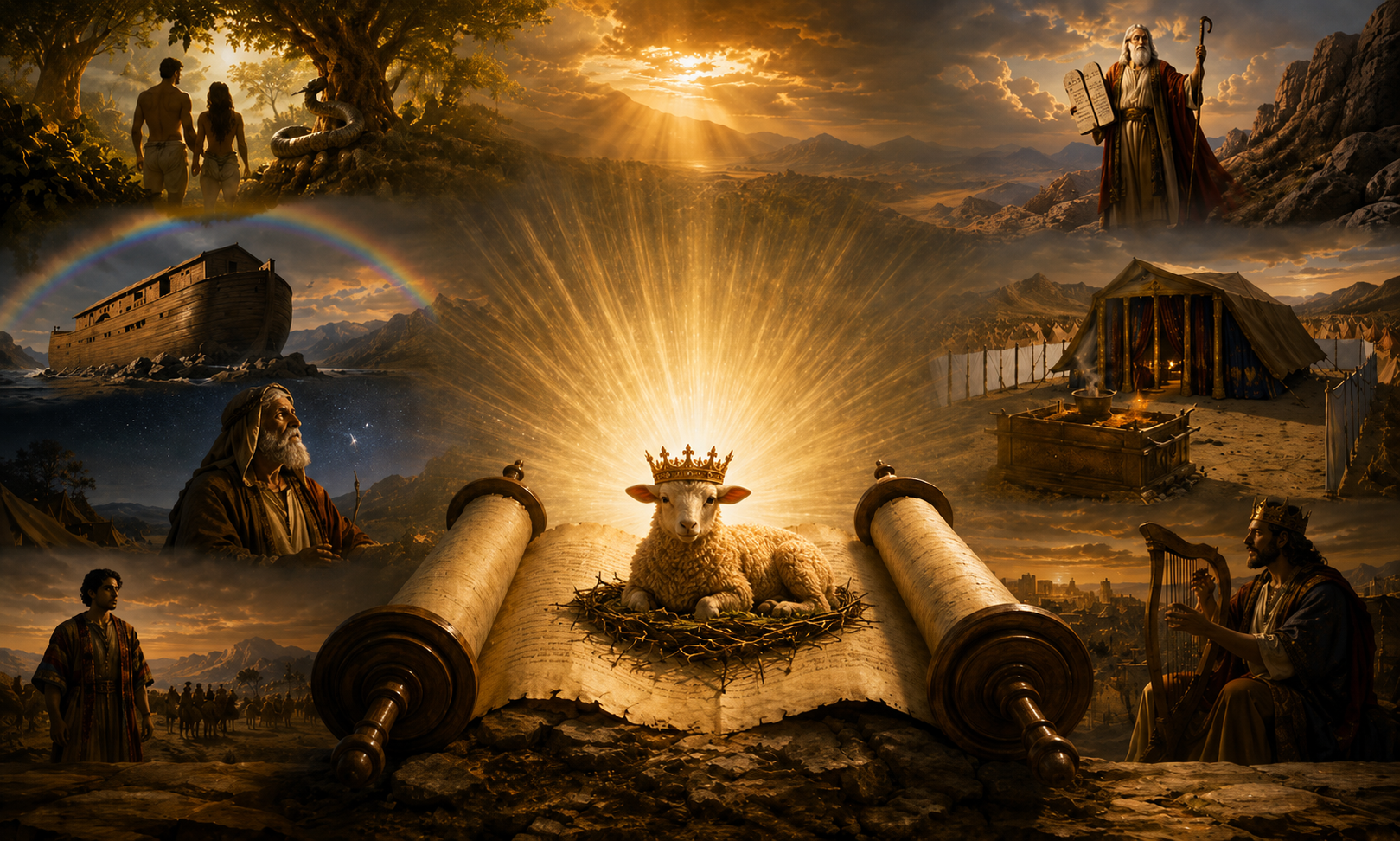
How can a story coherently convey its message without a unifying plot? Sadly, this is how many Christians have been taught to read the Old Testament and the Bible as a whole. For many, the Old Testament is a collection of disconnected moral stories and sporadic proverbial quotes in books that are artificially and mechanically placed on top of one another. What is the unifying center of the Old Testament? Many Christians would say Israel. But this is not the center that Scripture itself gives us, and a misplaced center will result in an incorrect reading of the Old Testament.
Seeing Christ as the Center of Scripture
Jesus Christ is the center of Scripture. He is the fulcrum point on which the whole Bible pivots. The Old Testament is the gospel promised. Its story moves to Christ. The New Testament is the gospel established. Its story moves from Christ. The whole Bible is a single story with Christ as the central figure. This is the testimony of Jesus and the apostles in the New Testament. Two brief examples of this testimony are seen in Luke and John’s Gospels.
Beginning with Moses and all the Prophets, he interpreted to them in all the Scriptures the things concerning himself….“that everything written about me in the Law of Moses and the Prophets and the Psalms must be fulfilled. Then he opened their minds to understand the Scriptures, and said to them, “Thus it is written, that the Christ should suffer and on the third day rise from the dead, and that repentance for the forgiveness of sins should be proclaimed in his name to all nations, beginning from Jerusalem (Luke 24:27, 44-47).
You search the Scriptures because you think that in them you have eternal life; and it is they that bear witness about me… For if you believed Moses, you would believe me; for he wrote of me (John 5:39, 46).
In both passages, Jesus teaches that the entirety of the Old Testament is about Himself. All the Old Testament promises and covenants are ultimately fulfilled in Christ. As Paul says, “For all the promises of God find their Yes in him. That is why it is through him that we utter our Amen to God for his glory” (2 Cor. 1:20).
Not only is Jesus the center of the Old Testament, but Luke 24:46-47 teaches us that the focus of the Old Testament is the sufferings and glories of Christ and the kingdom/church building project. But what text or texts in the Old Testament explicitly mention the death, resurrection, exaltation of Christ, the building of the kingdom of Christ, and the preaching of repentance and forgiveness of sins to the nations? Richard Gaffin Jr. answers the question this way,
Since no one Old Testament passage mentions together the Messiah’s death, resurrection, and the church, either verbatim or as a paraphrase, ‘it is written’ [Lk. 24:46] is best to read in a looser, more general sense that his death and resurrection are its integrating focus [of the Old Testament]. The various parts and diverse teaching of the Old Testament have their coherence and unity in him [Christ].[1]
In other words, when Jesus says “It is written” in Luke 24:46, Jesus is weaving together all the strands of the Old Testament and interpreting them in light of Himself. The Old Testament is one coherent prophetic and promissory ministry that points to Christ and the building of His kingdom. This means that the Old Testament must be interpreted from the vantage point of the New Testament, where we see Christ’s work of redemption accomplished (Heb. 1:1-2). The New is concealed in the Old, and the Old is revealed in the New.
Therefore, the Old Testament is Christian Scripture. The apostles and the Early Church did not hijack the Old Testament from the Jews and turn it into something it was not. The God of the Old Testament is the same as the God of the New Testament, and the gospel of the Old Testament is the same gospel found in the New Testament. This means that reading the Old Testament as a Christian is simply reading it as the Spirit of God intended, with the veil removed (2 Cor. 3:12-18).
Reading the Old Testament with Christ as the Center
Instinctively, every Christian wants to affirm that Christ is the center of the Old Testament. But when it comes down to the brass tacks, many Christians struggle practically with how to read the Old Testament in this way. I want to offer seven ways to see Christ in the Old Testament so that we do not miss the center.
1. Covenant Theology
The first way that we find Christ and interpret the Old Testament rightly is through covenant theology. Covenant theology forms the structure of Scripture and is the heart of God’s relationship with His creation and people. The Old Testament covenants and their promises are fulfilled in Christ. This is why Paul refers to the Old Testament covenants as “covenants of promise” (Eph. 2:12). Christ is the fullness and substance of what they point to. Christ fulfilled the Adamic/Noahic covenant as the second Adam and true image of God (Mark 10:45; 14:62; 1 Cor. 15:45; 2 Cor. 4:4). Christ fulfilled the Abrahamic covenant as the true seed of Abraham (Gen. 22:17b-18; Acts 3:25-26; Gal. 3:16). Christ fulfilled the Mosaic (old) covenant as true Israel and God’s true obedient Son (Ex. 4:22-23; Is. 49:3, 5-6; Matt. 3:17; 11:2, 19; 12:42; 13:54; Jn. 2:19-21; Acts 3:25-26; Rom. 5:19; Col. 2:17; Heb. 9:9-12; 10:1). Christ fulfilled the Davidic covenant as the greater Son of David (Matt. 2:2; 21:9; Lk. 1:32-33; Acts 2:29-31).
The Father gave His Son as a covenant for the redemption of sinners, and the Son’s work of redemption is the foundation for the New Covenant (covenant of grace). Therefore, paying attention to the covenants between God and man in the Old Testament will direct our gaze to the fullness of Christ, who was given as a covenant for us (Is. 42:6-7).
2. Typology
The second way to find Christ is through typology. A type is a divinely ordained analogy (picture) in a person, event, or institution in redemptive history that points forward to a greater reality. Adam is a type of Christ (Rom. 5:14). The ceremonial law (food, clothing, and festivals) of the Old Covenant was a type of Christ (Col. 2:16-17; Heb. 9:8-11; 10:1). The sacrifices of the Old Covenant were a type of Christ. The gospel was communicated through the types to the Old Testament saints.
Although the price of redemption was not actually paid by Christ until after His incarnation, yet the virtue, efficacy, and benefit thereof were communicated to the elect in all ages, successively from the beginning of the world, in and by those promises, types, and sacrifices wherein He was revealed...[2]
But this does not mean that everything in the Old Testament is a type of Christ.
Here are five rules for identifying types in Scripture. First, a type must have a textual warrant, but this does not mean a text must explicitly declare a person, institution, or event to be a type for it to qualify biblically.[3] Quotations, allusions, and parallels of Old Testament passages are often good indicators of typology. Additionally, a type must be grounded in history. It is a real historical event, person, and institution. Typology is not allegory. A typological reading of Scripture is inspired by the Holy Spirit and tethered to the ground in history. An allegorical reading of Scripture divorces the text from the historical literal meaning of the text.
Third, a type must correspond to the greater thing it signifies. For example, Adam is the federal head over all of humanity in the covenant of works. Christ is the federal head over all the elect in the covenant of redemption. There is a correspondence, a parallelism, between Adam and Christ’s work as covenant representatives. Fourth, a type must escalate to its final fulfilment. Last, a type must be interpreted in view of the covenants. The typology of the Old Testament is inspired by the Holy Spirit to help us see Jesus. It was through those types that the gospel was revealed to the Old Testament saints, and it is through these types that we see Christ as we read the Old Testament.
3. Promise
The third way is in the promises of God. The Old Testament is full of promises that the Lord gives to His people. This point is closely associated with “Covenant Theology” since many of these promises are given in covenants. These promises are fulfilled in Christ. Therefore, when we encounter them in the text, we should immediately ask, “How does Christ fulfill this promise? How does the New Testament church enjoy this promise in Christ?”
Let me give you two New Testament examples that demonstrate this point. The apostle Paul in Galatians 3 teaches us that Christ is the singular true seed of Abraham. The promises to Abraham’s offspring, physical descendants, are fulfilled in Christ (Gal. 3:16). All the nations are blessed through Abraham because Christ is the fullness of the Abrahamic covenant’s promises (Gal. 3:14). The nation, the land, and all the physical promises were temporary and preparatory for the coming of Christ. If we read the Abrahamic covenant apart from Christ and the New Testament, we might be tempted to treat Abraham’s physical offspring as an end in itself. But the physical offspring of Abraham is an end in Christ. This is why Paul goes on to teach that the true children of Abraham, the true sons of God, are those in Christ by faith (Gal. 3:8, 26-29; 6:16; see also Rom. 9:6-8).
The second example comes from Acts 2 in Peter’s Pentecost sermon. This sermon is a classic example of how to rightly read the Old Testament with Christ as the center. In this sermon, Peter shows how Christ is the fulfillment of the Davidic covenant through two Psalms written by David. First, he connects Christ’s resurrection to Psalm 16 (Ps. 16:8-11). Peter says that David in this Psalm was speaking as a prophet about Christ’s resurrection because of the oath God swore to him in the Davidic covenant (Acts 2:25a, 29-31; 2 Sam. 7:12-13). The Psalm could not have ultimately been about David because David died, and he stayed dead. The Psalm was ultimately about a greater son of David who would sit on the throne forever. The greater Son of David died and resurrected from the dead, fulfilling the promise of Psalm 16.
Second, Peter connects Christ’s ascension to Psalm 110 (Psalm 110:1). David certainly did not ascend into glory and sit at the right hand of the Father, but Christ did. In short, Peter interprets the resurrection and ascension of Christ as direct fulfillment that David’s son would forever sit upon the throne of David.[4] So, when you find a promise, look for Christ. Keep your cross-references handy. Search the New Testament to see if the Holy Spirit has given us a clear interpretation of how these Old Testament promises are fulfilled in Christ.
4. Prophesy
The fourth way is in the prophecies of the Old Testament concerning Christ. The opening chapters of Matthew, Mark, and Luke overwhelm the reader with the number of Old Testament prophesies fulfilled in the birth of Jesus Christ. The Gospel writers often indicate this fulfillment with an explicit quotation of the Old Testament prophecy, which is marked by indentation in our English Bibles (Matt. 2:6; Mic. 5:2).
However, the Gospels also demonstrate how Jesus’ ministry fulfills numerous Old Testament prophecies. In Luke 4, Jesus read Isaiah 61:1-2 in the synagogue in Nazareth,
The Spirit of the Lord is upon me, because he has anointed me to proclaim good news to the poor. He has sent me to proclaim liberty to the captives and recovering of sight to the blind, to set at liberty those who are oppressed, to proclaim the year of the Lord’s favor (Luke 4:18-19).
Then, He declared that this Scripture had been fulfilled that very day (Lk. 4:21). Jesus declared Himself to be the Spirit-anointed Servant of the Lord spoken of in Isaiah 61. Luke has already told his readers that the Spirit of God had descended upon Jesus at His baptism (Lk. 3:22; 4:1). Now, Jesus had begun His ministry of proclaiming liberty to those in bondage and blinded by sin. This proclamation is grounded in the redemptive work Jesus came to accomplish through the blood of His cross. The year of the Lord’s favor had come in redemptive history!
Another example is found in Matthew 4:12-16. When Jesus departed from Nazareth after the arrest of John the Baptist, He went into the region of Capernaum. Matthew explains the purpose of this relocation, “so that what was spoken by the prophet Isaiah might be fulfilled” (Matt. 4:14). Then Matthew quotes Isaiah 9:1-2 to show which Old Testament text was fulfilled (Matt. 4:15-16).
We often miss both the significance and fulfillment of these prophecies for two reasons. First, it is because we are ignorant of the Old Testament Prophets. The Gospel writers assume that the reader is steeped in the Old Testament. If this is not true, then we will miss Christ in the Prophets and underplay the significance of what the Gospel writers are saying about Him. Second, unbiblical presuppositions about how these prophecies will be fulfilled cause us to miss their fulfillment in Christ altogether. The point in these examples is that when you find yourself in those strange prophetic books, keep an eye out for the prophecies about Christ. Constantly ask the vital question when reading the Old Testament, “Does the New Testament quote or allude to this text, showing how it is fulfilled in Christ?”
5. Thematic
Fifth, the organic and unified story of Scripture gives us a plethora of themes that unfold, escalate, and crescendo in Christ along the redemptive epochs of creation, fall, promise, redemption, and consummation.[5] The story of Scripture organically and progressively unfolds. It shoots up like a plant from a seed buried in the ground. The plant in its maturity looks radically different than the seed, but nothing in the plant was not in the seed. The themes of Scripture are planted in seed form in Genesis. They begin to come out of the ground throughout the Old Testament, but they reach their full bloom in Christ in the New Testament.
At this point, it is helpful to see how a theme progresses and culminates in Christ. Consider the theme of sonship. Adam is God’s protological son (Gen. 1:26-27; 5:1; Lk. 3:38).[6] Israel is God’s typological son (Ex. 4:23; Hos. 11:1). Israel’s sonship narrows in on David’s kingly line (2 Sam. 7:14; Ps. 89:26-29). Jesus Christ is God’s eschatological Son (Ps. 2:7; Matt. 2:15; Lk. 3:38; Rom. 1:4). Each son belongs to a distinctive covenant: Adam and the covenant of works, Israel and the Old Covenant/ David and the Davidic covenant, Christ and the covenant of redemption. These covenants detail the obedience God requires of His sons.
But Adam was an unfaithful son, failing to earn by his obedience eternal glorified life with God for all of humanity. Israel was an unfaithful son, forfeiting life with God in the land as God’s treasured possession. David and his sons were unfaithful, failing to obey all that God commanded. The story of the Old Testament is about disobedient sons. The spiral of disobedience begins with Adam and ends with Israel exiled from the land of promise, and David’s throne vacated.
However, the story of Scripture does not end there. Jesus Christ comes as the second Adam, true Israel, and David’s greater Son. He is the son of David, the son of Abraham, the son of Adam, the son of God (Matt. 1:1; Lk. 3:38). He is the eschatological promised Son. By “eschatological,” this does not mean that the second Person of the Trinity became the “Son” in the incarnation. He is eternally the begotten Son apart from God’s works of creation and redemption. But as the Son of God incarnate, He is the promised Christ. He fully obeyed all that the Father commanded to secure redemption for His people through obedience (Is. 42:6-7; Jn. 17:4; Heb. 2:10; 5:8-9). The other sons were disobedient, but Christ was obedient, even to the point of death on the cross (Php. 2:8).
This is how the theme of sonship unfolds and culminates in Christ. But there is one more step. There is a fourth son. The church united to Christ is God’s adopted son (Jn. 1:12; Rom. 8:14-30; Gal. 4:1-7; Eph. 1:5; 1 Jn. 3:2; Rev. 21:1-6). Those united to Christ receive the blessings of sonship based on His obedience for them. Therefore, there are no formal conditions in the covenant of grace for sonship. All the conditions have been met for the redeemed in Christ. What a glorious thought!
Therefore, every theme in Scripture gives us a different glimpse of the majesty and beauty of Christ, both in His Person and work for us. Use these themes to see Christ in the Old Testament. When you encounter one, begin to trace the unfolding line to our blessed Savior!
6. Offices of Christ
The sixth use is straightforward. Christ in His office as the only mediator between God and man is a prophet, priest, and king (1 Tim. 2:5).[7] He is the greater Prophet Moses spoke of (Deut. 18:15; Acts 3:22), and He reveals the Father to His people (Jn. 1:18; Matt. 11:27). He is the great High Priest who is seated in glory because His sacrifice is sufficient for all time for the salvation of sinners (Heb. 7:25; 10:14). He is the Davidic King that will reign on the throne of glory forever, conquering the enemies of His people (Acts 2:29-35; Rev. 5:5; 11:15).
But what does this have to do with finding Christ in the Old Testament? The Old Testament is filled with prophets, priests, and kings appointed by God. But all those
prophets, priests, and kings are insufficient to be the mediator that sinners need. They are sinners themselves and therefore, insufficient to reconcile men to God. Yet every time you see these offices in the Old Testament, they are like signs that point you to Christ.
7. The Angel of the Lord
The seventh use is the Angel of the Lord. Jesus is not just prophesied, promised, or pictured in the Old Testament. Jesus is present as the preincarnate Angel of the Lord. This is why Jude 5 says, “Now I want to remind you, although you once fully knew it, that Jesus, who saved a people out of the land of Egypt, afterward destroyed those who did not believe.” Did you catch that? Jude said “Jesus” saved a people out of Egypt! How can that be? Furthermore, other New Testament texts indicate that the Old Testament saints saw a physical manifestation of the Son of God before the incarnation (Jn. 8:56; Jn. 12:41).
But what specific Old Testament passages prove that the Angel of the Lord is the preincarnate Christ? Let me give you a sample of the evidence. The Angel of the Lord swore by Himself the promises of the Abrahamic covenant (Gen. 22:15) and redeemed Jacob (Gen. 48:15-16). He spoke to Moses from the fiery bush (Ex. 3:2-6), guarded and guided Israel in the wilderness (Ex. 14:19; 23:20), and drove out the inhabitants of the promised land (Ex. 23:23; 33:2; Josh. 5:13-14). He bore God’s name (Ex. 23:21). He is called the Angel of God’s presence and the messenger of the covenant (Is. 63:9; Mal. 3:1). When Manoah realized, he and his wife had seen the Angel of the Lord, Manoah said, “We shall surely die, for we have seen God” (Judg. 13:22).
We must remember that God does not share His name or His glory with creatures. These names and actions ascribed to the Angel, along with the reaction of God’s people to the Angel, leave us with little conclusion that this is no creaturely angel. This is the eternal and uncreated Son of God, revealing Himself to His people in a pre-incarnate state. So, when you see the Angel of the Lord, rejoice, for Christ is present!
Conclusion
Your aim is now focused on the right Person. Take up and read the Old Testament like a Christian! But a final caution must be given. Reading all of Scripture with Christ at the center must produce worship, love, and adoration for Him. When worship is absent, you have missed Christ. You may know all about the center. But you have turned the glory and beauty of the person of Christ into an abstraction or common intellectual hobby. A true encounter with Christ in all of Scripture will always produce worship. All of Scripture proclaims to us the words of the Father, “This is my beloved Son, listen to Him!”
[1] Gaffin, Word and Spirit, 13.
[2] The Second London Baptist Confession, 8:6.
[3] Joseph is a type of Christ, though Scripture does not explicitly state this. But when we look at Stephen’s sermon in Acts 7, Joseph’s life is portrayed as a picture of Christ life- suffering then glory.
[4] Peter did not look for a future resurrection of a geo-political kingdom of Israel where Christ would sit physically on a throne in Jerusalem.
[5] Here is a sample of the themes found in Scripture: kingdom, divine presence, sonship, sacrifice, creation, marriage, exodus, kingship, priesthood, and mountain/city.
[6] Protology simply means the original or first. Adam is the original or first son of creation.
[7] The Second London Baptist Confession 8:9-10.